Process · From sketch to finished pop-up
How Bruce Foster designs and engineers a pop-up
Every pop-up Bruce engineers starts as a rough model in plain paper, cut and taped by hand, and is rebuilt until the movement works. This page follows the stages, in his own words and photos.

In Bruce’s words
Why pop-ups
Pop-ups, whether they are for a book, a card, a product, or even a movie, are my passion. The magic of transforming flat paper into moving, evolving, three-dimensional structures captivated me from the first time I ever saw one. The goal, of course, for every pop-up is to recreate a vision or a facsimile of a real or imagined thing. But the best pop-ups do so in a way that is transformative on another level: elevating them to works of art. If I may, to dance the structure into being. Or as Buzz Lightyear might have said, “popping it up with STYLE!”
In my career thus far, I have engineered more than 65 published books, hundreds of cards, and many more paper objects.
Bruce Foster
Design
The stages of designing a pop-up
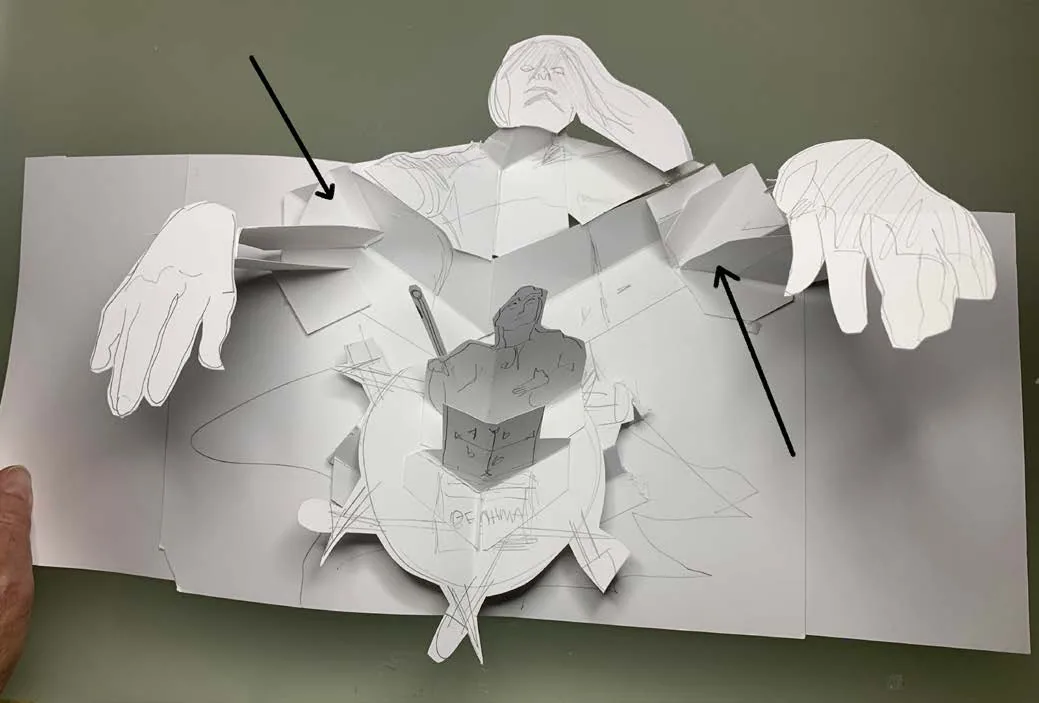
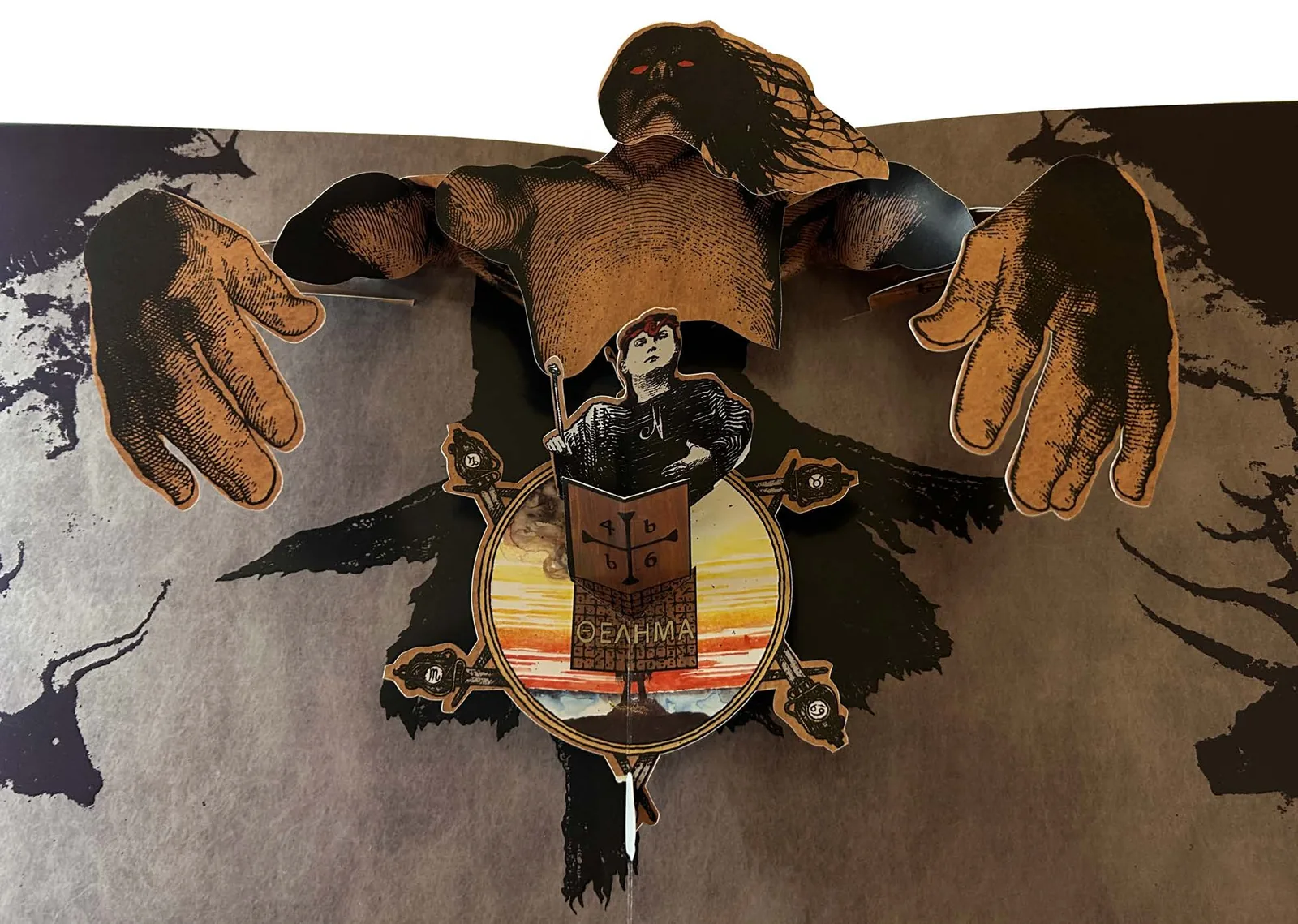
Below as an example, one spread from Macken, The Journey: The Pop-Up Book as it took shape.
- Rough cut. From a pencil sketch or other reference, a rough cut is built, exploring and adjusting the design.
- Refine. A second, third, or even fourth version is built and refined, combining mechanisms whenever possible for efficiency.
- Take apart and scan. Then the pop is disassembled and the pieces scanned.
- Die lines and art. Die lines are created in Adobe Illustrator, art is inserted into the die lines, printed, hand cut, and a more complete version is built.
- Final copy. Further refinements are made, artwork is completed, and a final hand made copy is constructed.
Article by Bruce Foster
The Pop-Up Book is a Hand Full. Well, Many Hands Full!
“Every pop-up book is a hand-made book. It matters not if there is only one copy ever made, or if there are hundreds of thousands of duplicates. Each is still…HAND-made.”
Bruce’s account of how a pop-up book comes into being, from his first rough model to the printer’s assembly teams, with photos of every stage. Previously published in Bound & Lettered and Book Arts arts du livre Canada.
- Every copy is made by hand. Pop-up books are produced commercially in the thousands, even as many as three hundred thousand, and each copy is still hand-made. In Bruce’s words, “There is no machine that can adapt or have the finesse necessary to mass produce them.”
- Studio paper. Bruce builds his models in WestRock Tango, 231 gsm, 12 point, coated on one side only. It is similar in specifications to the stock that the printer will eventually use.
- Nesting sheets. All the pieces are cut from large printed sheets (28 by 40 inches is the norm). The printer’s sheet that houses all the pieces is called a nesting sheet, and a pop-up book will require from 1 to upwards of 10 or more of these.
- What drives the cost. The size of the book and the complexity of the engineering both decide how many sheets are necessary. Larger books need more paper. Complexity adds cost in two ways: the steel dies are larger and more abundant, and every spot of glue or hand-folded piece means more interaction and time in assembly. For some projects Laser cutting is possible. This is an option for very fine, delicate, cut-outs. But it takes longer so I normally only use this for short runs.
- Bleed and knock-outs. Every piece gets at least 3/16 inch of bleed, otherwise unprinted white paper could show after the cuts. Ink is kept off the spots where glue will go, for the best results of the glue. These are called K/O’s, or knock-outs.
- What goes to the printer. A color model, the files, and any instructions if needed. The printer then cuts out and assembles a working model for approval.
- Assembly. Teams are convened to address a single spread from the book, each member assigned only one or two steps. Sometimes there are over a thousand people working on the same book.
Working with Bruce
How a commission works
“Concept, collaboration, design, press-ready production, and coordinating with the printer, yours OR mine.”
- Concept.I start with your idea, story or product, and what you want the paper to do.
- Collaboration. Working with your writer, illustrator, art director or brand team, we develop the project together. I can also illustrate the project myself as an option.
- Design. I sketch a draft pop-up, cut and assemble it, and rebuild it over and over until the movement works. Then I draw the shapes and fold lines on the computer.
- Press-ready production. You receive production files prepared for printing, cutting and assembly.
- Printing. Then I coordinate with the printer, yours or my preferred vendors, through the production to finished copies in your hands.
From the Homo Faber Guide interview
How do you conceptualise a pop-up piece?
I sketch a draft pop-up, where I experiment and work out the basic form and movement by cutting and assembling the paper. Rebuilding it over and over, I make adjustments until things work perfectly, then I draw the shapes and fold lines on the computer.
Bruce Foster, Homo Faber Guide
What does a paper engineer do?
A paper engineer designs the cuts, folds and glue points that make flat printed paper rise, move and fold flat again when a page is turned. Bruce sketches a draft pop-up, works out the form and movement by cutting and assembling paper, rebuilds it until everything works, and then draws the shapes and fold lines on the computer so a printer can produce it.
Are pop-up books made by machine?
No. Every pop-up book is assembled by hand, whether one copy is made or hundreds of thousands. As Bruce writes in his article on how pop-up books are made, “There is no machine that can adapt or have the finesse necessary to mass produce them.” At the printer, teams are convened to address a single spread from the book, each member assigned only one or two steps.
How is a pop-up different from origami?
In Bruce’s words, origami results in a static sculpture and most often uses a single piece of paper in its entirety, uncut. A pop-up “transforms each and every time it is activated. It is flat, it is formed, it is flattened, over and over again.” It is built of many intricately cut pieces assembled into a new structure with glue or locking mechanisms.
How long does a custom pop-up book take?
Every project is different, so the schedule is set project by project and agreed as part of the quote. It depends on the size and complexity of the piece, the quantity, and how it will be printed and assembled. As one example, the eight-foot-tall, four-spread Christmas book for Crossroads Church was designed, printed, hand cut and assembled in six weeks, including seven smaller two-spread versions for the church’s other locations. But a commercial book project can take a year or longer.
Tell Bruce about your project and your deadline, and he will let you know what is realistic.
How much does a custom pop-up book cost?
Every commission is one of a kind, so there is no price list. Bruce quotes each project individually. A quote is typically shaped by the number of spreads, the complexity of the pop-ups, the size of the piece, the quantity, and how much hand assembly is involved.
The best way to move forward is to begin with an introductory meeting, usually via Zoom (or Teams). If the project structurally resembles another previous project, quotes are easily assembled. Often though, the project has too many new variables and the project will need to go through an R&D stage. Bruce structures the quote to incorporate this stage without committing the client to a full process should the project turn out to be not viable for one reason or another. That way, only work performed is committed. However, this rarely happens.
Commissions and bookings
Have a pop-up in mind?
Tell me what you have in mind, large or small. I can handle your project from end to end: concept, collaboration, design, press-ready production, and coordinating with the printer, yours or mine.